
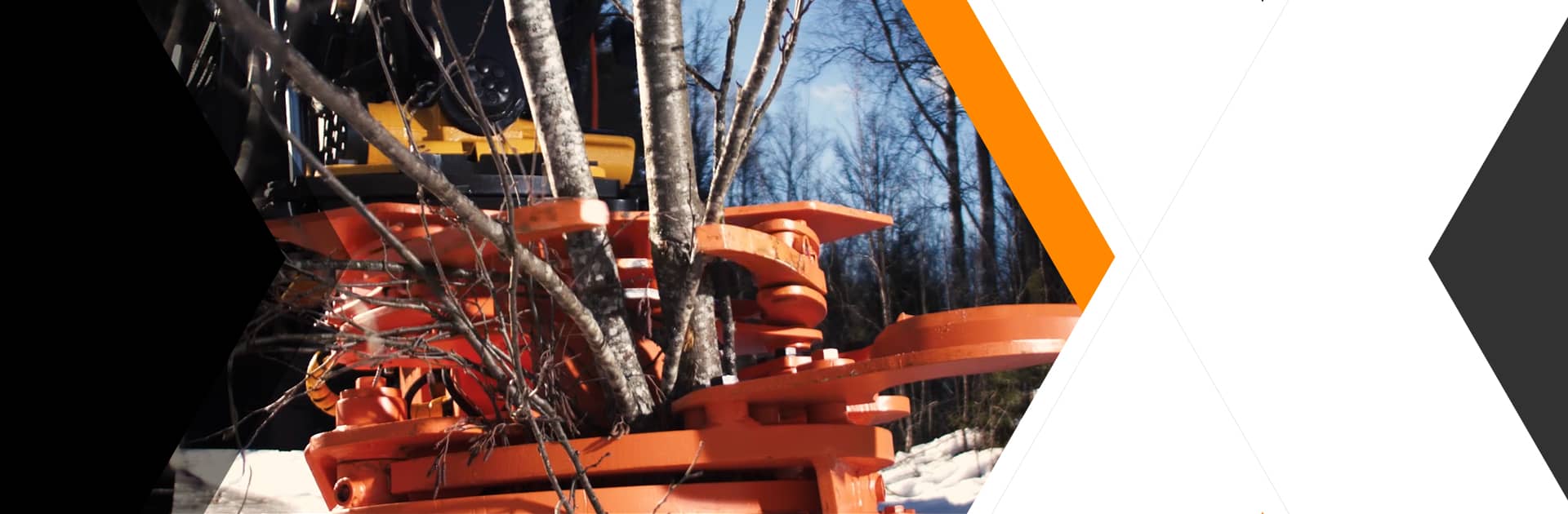
Excavators in the 5–8 tonne class are widely popular, versatile carriers. They maneuver effortlessly through dense thinning stands, urban jobsites, and roadside ditches while delivering the stability and lifting power needed for productive biomass harvesting. When selecting a tree shear for this machine class, finding the right balance between attachment weight, cutting capacity, and carrier capabilities is crucial. Machine durability, mass distribution, and carrier hydraulic parameters must all be carefully considered.
If an attachment is too heavy, machine stability is severely compromised when the boom is fully extended forward or over the side. Conversely, an excessively light structure cannot endure continuous professional contracting loads. Hydraulic output – specifically oil flow and operating pressure – dictates how swiftly and forcefully the cutting blade shears through wood. Selecting the ideal tool for a 5–8 tonne carrier requires analyzing both mechanical balance and hydraulic compatibility. In this weight range, the Finnish Axer range provides two proven solutions: the lighter Axer 230 K or the heavy-duty Axer 540 K tree shear.
Machine Stability and Weight Limits: Every Kilogram at the Boom Tip Counts
Safe load handling depends directly on center-of-gravity control. On 5–8 tonne excavators, extra weight at the end of the dipper arm quickly impacts machine balance. At full outreach, even a minor weight increase multiplies torsional forces on the undercarriage. Because professional operators must work safely across slopes and soft ground, attachment tare weight must align strictly with the machine’s lifting chart.
Within the 5–8 tonne bracket, exact machine weight determines the ideal Axer model:
- 5–6 tonne excavators: For this lighter bracket, a weight-optimized shear such as the 270 kg Axer 230 K is recommended. It delivers an impressive 250 mm maximum cutting capacity without compromising carrier stability, even at maximum reach.
- 6–8 tonne excavators: For this heavier class, the Axer 540 K is the optimal choice. Its 380 kg tare weight brings heavy-duty robustness without sacrificing machine agility. The box-frame design, manufactured from high-strength wear steel (Hardox/Dillidur), optimizes the strength-to-weight ratio by focusing material in high-stress zones while keeping non-critical areas light.
Choosing an appropriately weighted shear protects pins, bushings, and cylinders from premature wear. An overly heavy tool generates severe dynamic stress every time the carrier swings or the boom accelerates. A lighter, optimized structure minimizes sway, enhances control, and simplifies grapple positioning at tree bases in difficult terrain.
Hydraulic Flow and Pressure: Balancing Speed and Power
High-output harvesting requires rapid duty cycles where cutting and loading happen without delay. The operating speed and gripping power of a tree shear depend directly on the excavator’s hydraulic circuit. Compatibility is evaluated through two key metrics: oil flow rate (l/min) and maximum operating pressure (bar).
Oil flow determines the speed at which the cylinder extends and retracts the cutting blade. On 5–8 tonne excavators, auxiliary lines typically deliver 50–90 l/min. Axer shears are engineered for peak performance within these flow ranges: the lighter Axer 230 K operates efficiently at a recommended minimum flow of 50 l/min, while the larger Axer 540 K requires at least 75 l/min for rapid cycle times. Adequate flow ensures quick opening and closing, minimizing cut duration per tree. Insufficient oil flow prolongs cutting cycles, lowering productivity and increasing fuel consumption per cubic meter harvested.
Operating pressure determines raw shearing force. Axer tree shears are rated for working pressures up to 300 bar. This high pressure rating produces massive shearing force without requiring larger cylinder diameters or increased attachment weight – a distinct advantage for 5–8 tonne carriers aiming to harness hydraulic power without adding boom-tip mass.
OPTIMIZED CYLINDERS AND BOX-FRAME DESIGN
Engineered and manufactured in-house by Axer, the cutting cylinder maximizes hydraulic efficiency and provides optimal cutting geometry. The box-frame chassis made of high-strength wear steel (Hardox/Dillidur) distributes structural loads evenly and prevents frame deflection during heavy felling, ensuring long operational life.
When hydraulic flow and pressure are properly balanced, the cutting cylinder operates at peak efficiency. For the operator, this translates to clean, single-pass cuts without bogging down the carrier engine. A properly matched system also prevents oil overheating, preserving hydraulic fluid and seal life in heavy professional use.
K-Model vs. L-Model: Bolted Blade or Patented Retractable Blade?
The Axer 540 series is available in two distinct configurations, allowing contractors to match the attachment directly to their operational requirements:
- K-Model (such as Axer 540 K): Fitted with a bolted, heavy-duty, easily replaceable cutting blade. This model represents the traditional, mechanically robust, and low-maintenance solution for general clearing and roadside maintenance.
- L-Model (such as Axer 540 L): Equipped with Axer’s patented retractable cutting blade. When the blade is hydraulically retracted into the protective chassis, the grapple can be used freely for loading, sorting, weeding, or clearing debris without risk of damaging the cutting edge – transforming it into a versatile multi-purpose timber grapple.
Cutting Performance and Methods: Guillotine Shear vs. Saw Grapple for Demanding Jobs
Understanding cutting methods helps prevent unnecessary downtime. The most common solutions for 5–8 tonne excavators are guillotine-style shears with fixed or bolted blades (like Axer K-models) and hydraulic saw grapples. A guillotine shear operates via powerful closing force pressing the timber against a rigid blade. Its key strengths are mechanical reliability, simplicity, and minimal maintenance. The blade requires no chain lubrication or sensitive adjustments and handles occasional contact with soil or rocks far better than a saw chain.
A saw grapple, by contrast, excels when cutting large-diameter timber cleanly without butt splitting – such as dismantling trees in residential zones or adjacent to utility lines. While guillotine cuts may cause slight butt fractures (inconsequential for bioenergy wood), they can reduce commercial timber value. For 5–8 tonne carriers, a mechanical guillotine shear is typically the most productive and reliable choice, as it avoids demanding the high continuous flow rates required by saw heads.
Mechanical Mounting and Control Systems: The Foundation of Smooth Operations
Carrier interface design directly influences safety and handling. In the 5–8 tonne bracket, standard quick couplers include S45 and S50. When choosing a mount, operators must account for both physical pin geometry and the cumulative weight that the coupler and tiltrotator add to the boom tip. In practice, every additional 10 kg at full reach noticeably reduces lateral lifting capacity.
Control options range from standard auxiliary hydraulics to integrated electric selector valves. In its simplest setup, the shear operates via standard dual-action auxiliary lines or tiltrotator extra circuits. This avoids routing electrical wiring along the boom, preventing cable snagging in dense brush. Axer tree shears are designed for seamless compatibility with all common coupler interfaces and control layouts.
Finnish Quality: Axer 540 K Tree Shear
Looking for a rugged, Finnish-made attachment tailored for a 6–8 tonne excavator? The Axer 540 K is engineered to meet tough contractor demands. Its dependable construction, custom-designed cutting cylinder, and wear-steel box frame deliver long service life and minimal maintenance requirements. A bolted, easily replaceable blade keeps downtime to a minimum.
Proper Sizing Ensures Maximum Productivity
When excavator operating weight, hydraulic delivery, and attachment capabilities are aligned, timber harvesting becomes both productive and cost-efficient. An improperly sized shear stresses the base machine, elevates fuel usage, and slows duty cycles. A well-matched setup protects your machinery and ensures high uptime. Professional contracting demands a mechanically strong build proven in challenging Nordic forestry conditions. Finnish Axer tree shears are designed and built in Kihniö by Konepaja Ala-Katara, backed by decades of engineering expertise and uncompromising quality standards – from father to son.
